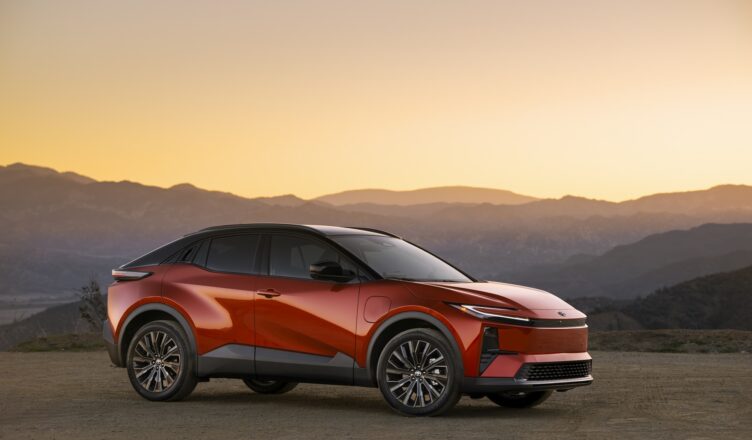
A few weeks ago, I drove the updated Toyota bZ electric crossover and thought it was excellent for families wanting to go electric without breaking the bank. But…, if I was buying something for myself, I’d like something a little sportier – maybe with edgier crossover coupe styling while still keeping all that made the bZ easy to enjoy. By utilizing essentially the same architecture while conjuring a name and style from its recent past, Toyota did just that with the 2026 C-HR.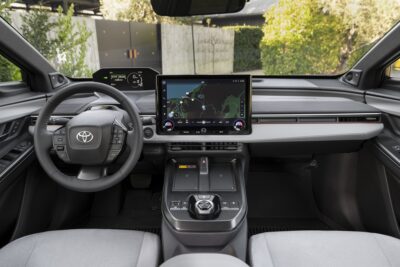
This is an entirely different vehicle with edgier dimensions, but Toyota was smart to use the C-HR name from the recent Corolla-based crossover. Even with tighter proportions than the bZ, the family resemblance is obvious – even if much of the design and underlying architecture is shared with the Subaru Uncharted.
While considerably larger, it looks like its gas-powered predecessor with a tall hatch roofline, deeply sculpted bodysides, rear doorhandles hidden in the pillar and spoilers extending from the roof. Up front, hammerhead styling ties it to the Prius, bZ and RAV4. Black trim and 20-inch gunmetal alloys give it a sinister aura. I think it looks especially handsome in our car’s two-tone paint with Midnight Black Metallic roof over Tandoori burnt orange.
Almost all of the interior is shared with the bZ, which is fine by me. There’s a wide 14-inch infotainment screen, 7-inch flatscreen gauges forward on the dash and twin wireless phone chargers in the console. Our XSE came with vegan suede and leather seats – heated in both rows. Steering wheel too. Add ventilation to the front deeply-bolstered buckets. All ride under a panoramic glass roof while listening to crisp JBL audio. Phones connect wirelessly through Apple CarPlay and Android Auto.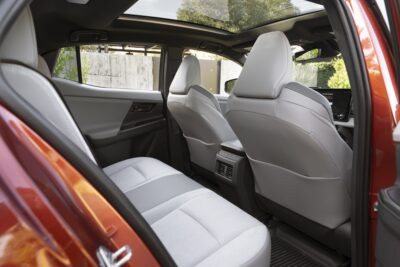
There’s a little less space under the sloping power hatch, but there’s plenty of space for a bicycle, stroller or IKEA haul with the split/fold seats deployed. Rear legroom is also tight, but adequate for kids and adults on short hops. Up front, the fly-bridge console provides convenient space for billfolds, baby wipes and gate cards.
Safety was paramount. Automatic emergency braking, adaptive cruise with lane centering and blind spot warning with intervention are included – as are rear cross traffic alert and safe exit assist to keep tots from stepping into traffic. I only wish it had hands-off cruising on the highway.
The C-HR received the same tweaks as the bZ to allow fast charging 10-80% in 30 minutes and a full recharge on 240v in about 7 hours. That’s an easy over-night replenishment. Better, Toyota adopts Tesla-style NACS charging ports to make it Supercharger compatible. Unlike its Subaru counterpart that can reach 300 miles in front-drive models, the XSE is “limited” to 273 miles fully charged. All C-HRs are all-wheel-drive. Still, that’s enough to prolong commutes and weekend shenanigans.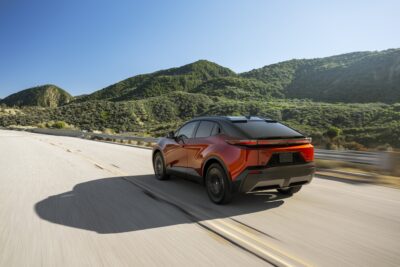
With a wide stance and weight low down in the chassis, you can toss it around on twisty two-lanes without losing composure. You will feel that battery weight when you chuck it into a corner, however those 20-inch wheels and all-wheel-drive keep it chopping along. Moving out is instant and silent given 338 horsepower and 323 lb.-ft. of torque. Click 0-60 mph in a scant 4.9 seconds. No matter the road, it just rumbles over without a squeak or creak.
I really liked the bZ, but this is the one I’d want for myself. It gives up a little range and utility, but gains dramatic styling, AWD, and halcyon acceleration. Toyota priced it right starting at $37,000 and coming to $41,979 as tested. Also consider the Chevy Equinox EV, Ford Mustang Mach-E, Hyundai IONIQ 5, Kia EV6, Tesla Model Y and similar Subaru Uncharted.
Storm Forward!
Send comments to Casey at AutoCasey@aol.com; follow him on YouTube @AutoCasey.
That’s really interesting to hear about the bZ, it seems like Toyota is getting quite confident with its electric offerings now.
Yeah, definitely. Toyota got off to a slow start with vehicles possessing too short range, but they are really doing well now.