The 1987 Nissan Pathfinder, based on the Hardbody pickup, was one of the first vehicles brought from sketch to production via Nissan Design International, the automaker’s studio in San Diego, California. It was a sensation with its angled side windows meant to evoke rollbars, three-triangle alloy wheels and three slots above the grille remain iconic. As families embraced SUVs, a four-door version was added for 1990. Its truck-based underpinnings allowed for some serious off-road capability.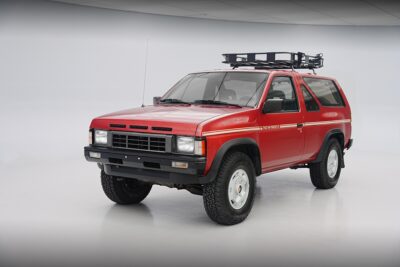
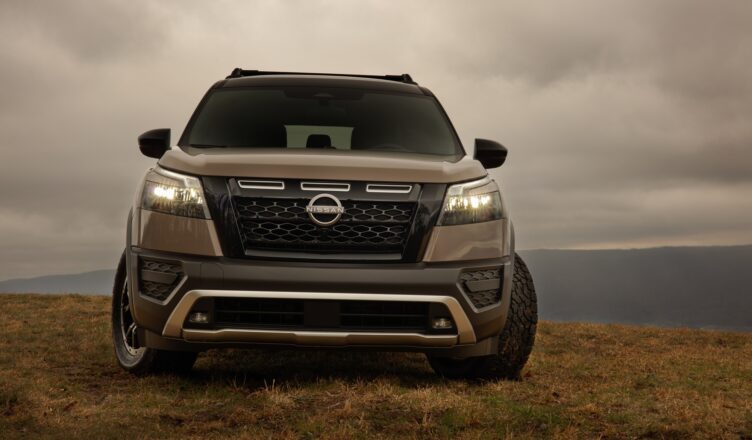
Through intervening generations, the Pathfinder went soft, evolving into a fat family-focused three-row crossover losing all pretention of capability beyond a snowy road. However, the latest generation in Rock Creek trim aims to regain its predecessor’s style and fortitude while carrying kids in the morning and smacking trails on the weekends. It does so with mixed success.
There’s no choice in number of doors, so the original Pathfinder’s distinctive window treatment is verboten, but the bulging fenders and three slots above the grille respect its ancestor. A black tubular roof rack and 18-inch black beadlock-style wheels look tough while two-tone paint with a black roof add debonair touches. Especially when parked next to the original, you can see it’s a big wagon best suited to carrying families and gear.
While the Rock Creek looks rock-ready, it’s best to survey trails carefully. Sure, it has 7.7 inches of ground clearance, a half-inch more than standard Pathfinders, but that’s significantly less than even a base Subaru Outback’s 8.7 inches (trail-focused Wilderness editions are lofted 9.5”). Classic Pathfinders reach between the Outbacks, so crossing actual rocky creeks should be done with caution. An off-road-tuned suspension does a good job of soaking up bumps and bruisers on-road and off.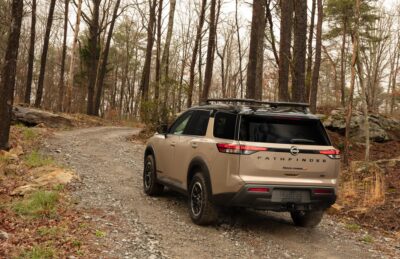
Fortunately, it’s pretty sublime on long expanses of pavement where its 3.5-liter V6 routes 295 horsepower and 270 lb.-ft. of torque to the all-wheel-drive system through a 9-speed automatic transmission. The terrain response system lets drivers configure the powertrain for an array of conditions, but it really needs a turbo to move three rows of passengers or the claimed 6,000 lbs. towing capacity with any authority. When unloaded, expect 20/23-MPG city/highway.
Looking at photos, it’s amazing how simple the old antique’s interior looks with analog gauges, manual climate controls, cassette player and cloth seats.
This one’s decidedly more upscale with leatherette upholstery, optional middle-row captain’s chairs and a third row for friends. And it gets better with a panoramic moonroof, heated front seats, heated steering wheel and tri-zone automatic climate control. Gone are all of the analog dials and controls, replaced with a 7-inch flatscreen instrument display and 12.3-inch touchscreen for connecting phones via wireless Apple CarPlay or Android Auto. Charge wirelessly in the console.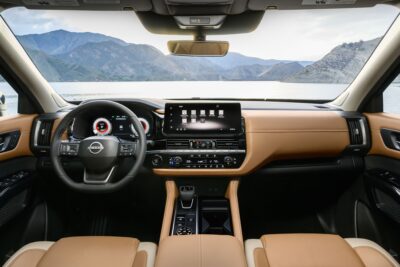
Safety technology has clearly advanced too as the Pathfinder Rock Creek comes standard with adaptive cruise automatic emergency braking, blind spot warning with intervention, and rear auto brake.
I like driving and riding in the Pathfinder Rock Creek, but I wish Nissan had taken the opportunity to really elevate its off-road capability. Add a couple of inches of ground clearance, fortify the roof rack for pop-up tents and give it a turbo for good measure. It’s a great start, and a stylish crossover owners will enjoy, but Nissan should go further.
While the original was built in Japan, this one hails from Smyrna, tariff-friendly Tennessee just south of Nashville. What hasn’t changed much is the Pathfinder’s price. A mid-grade two-door 1987 Pathfinder would have cost an inflation-adjusted $40,000, which is where the four-door-only 2026 edition starts. Stepping up to Rock Creek trim demands $45,090, rising to $50,215 as-tested. Competitors include the Chevy Traverse Z71, Ford Explorer Tremor, Jeep Grand Cherokee, Honda Pilot TrailSport, Kia Telluride X-Line, and Volkswagen Atlas Peak Edition.
Storm Forward!
Send comments to Casey at AutoCasey@aol.com; follow him on YouTube @AutoCasey.