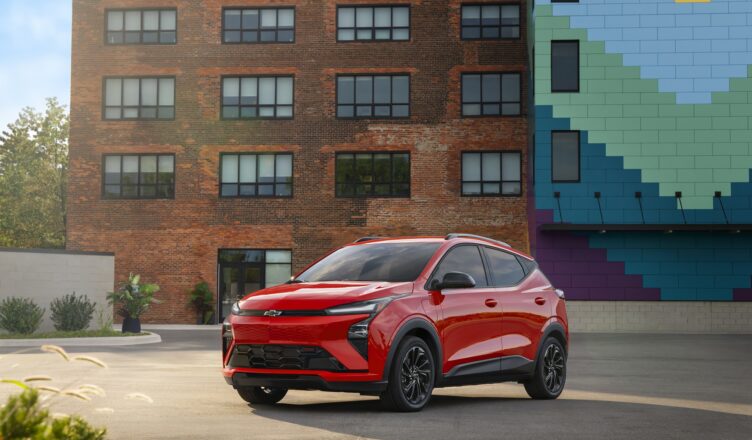
I remember driving the Chevrolet Bolt at its press preview in San Francisco, spending all day going up and down hills without worrying a wit about range. The compact EV launched for 2017 with 238 miles range, later extended to 259 miles by the time it was discontinued in 2023. Even after a day of hard slogging, there was still plenty left to return to the hotel.
Brilliant, and even more so as it returns from hiatus for 2027.
For its resurrection, Chevrolet took the old architecture, implanted new Ultium batteries and added NACS plugs. It takes about half the time of the old Bolt, charging 10-80% in 25 minutes. A 240v home charger does it in under 7 hours. Range increases just 3 miles to 262, but accessing it is much easier.
For maximum rear legroom, designers chose the longer EUV body shell – looking sharp in RS trim wearing 17-inch gloss black alloys and trim. It’s a roomy car with tall proportions for four very comfortable passengers (five in a pinch).
Upgrades continue inside with a completely new dash with wide flatscreen gauges, 11.3-inch touchscreen and wireless charger. Ambient lighting seeps from crevices. The gear selector moves to the steering column, freeing up console space. Our sporty RS came with automatic climate control, dual-panel sunroof, heated/ventilated front seats and a heated steering wheel. Driver lumbar stretches backs on extended drives.
It’s not all perfect. You can’t get Apple CarPlay or Android Auto on the Bolt. Pity because GM’s in-house menus are terrible. Having no start/stop button to shut everything down when you park is discomforting. It’s automatic, but I prefer immediate confirmation. Headlamps are controlled via an icon on the touchscreen – annoying, but most people set them on auto and leave them.
I spent most of my week driving to the office and back, which showed the Bolt’s utility as a city car, able to blip through traffic and recharge quickly. There’s no all-wheel-drive, but front-drive optimizes range. I also made a two-hour Interstate run to an outlet mall. Ratings of 210 horsepower and 169 lb.-ft. of torque seem light, but there was plenty of power to kick onto freeways with smooth bursts of acceleration for quick lane changes. Posting 0-60 mph in 7 seconds and passing time comparable to the 1980s Buick Grand National, it’s not slow.
And using Super Cruise was super easy. Once I left city traffic, I turned on cruise. Green lights lit up the steering wheel and off went the hands. The car even changed lanes and back again for slower traffic. There’s a sensor watching drivers, so no reading magazines or taking a nap, but I spent most of the drive relaxing with a cold soda in my hand.
The Bolt is stocked with safety systems that include automatic emergency braking, rear auto braking and blind spot warning with steering intervention. The rearview camera mirror lets drivers see out the back even with tall cargo aboard. GM’s safety alert seat vibrates in the direction of danger – or to let you know Super Cruise is changing lanes.
If it’s so good, then why only one year? Apparently, GM needs floorspace in its Fairfax, Kansas plant for gas-powered vehicles plus it also has the Equinox EV as a cost-competitive alternative. I just can’t help thinking GM is really doing something stupid by discontinuing the Bolt…again It’s just so good.
An advantage of using old architecture with updated technology is the ability to offer a compelling price. Bolts start at just $27,600, rising to $38,940 with our Super Cruise-equipped RS. That’s formidable competition for the Hyundai IONIQ5, Kia EV3, Nissan Leaf, Subaru Uncharted, Toyota C-HR and upcoming Mitsubishi Eclipse Sportback EV.
Storm Forward!
Send comments to Casey at AutoCasey@aol.com; follow him on YouTube @AutoCasey.